HomeRiskIQ · Published October 25, 2026
Short gaps between severe weather report dates in two Colorado counties
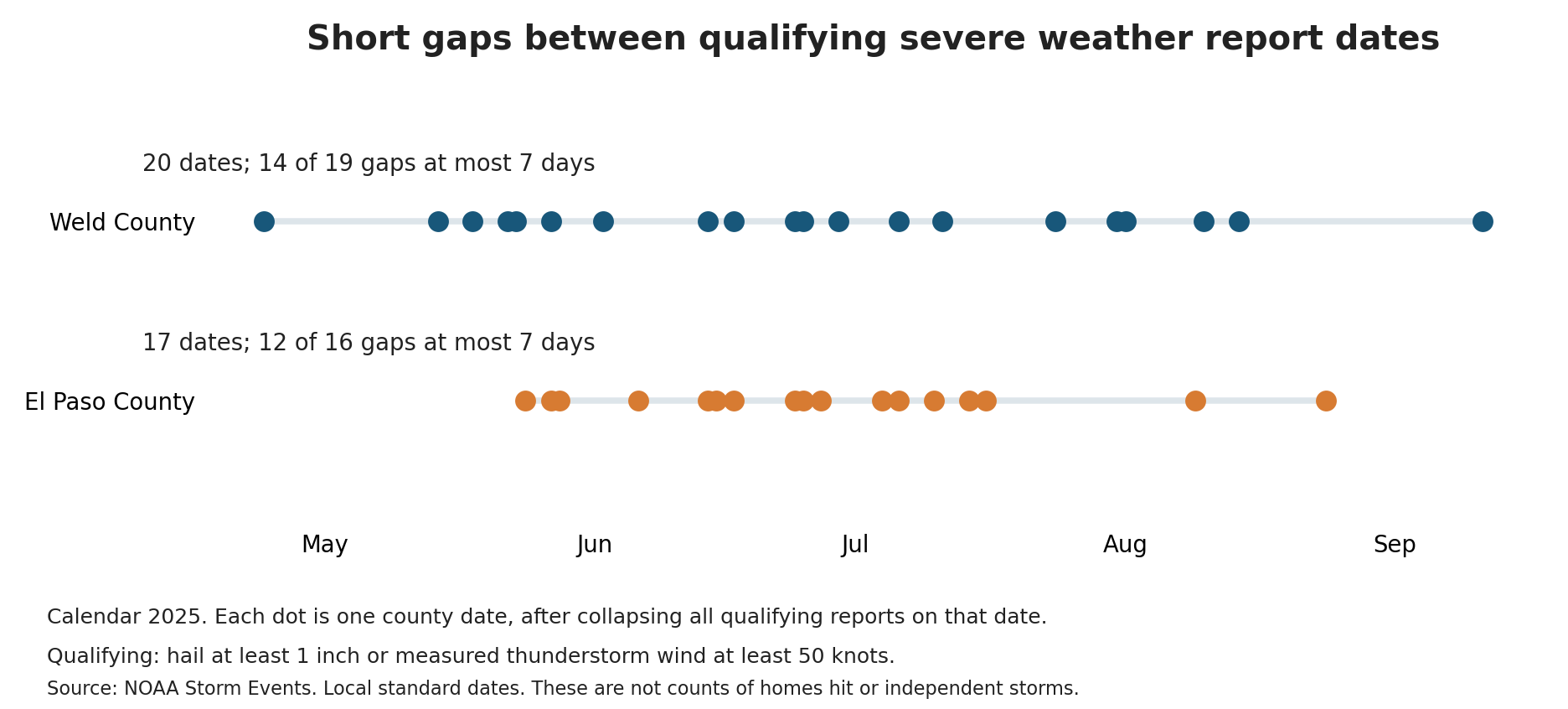
In NOAA’s 2025 record, qualifying hail or measured thunderstorm-wind reports occurred on 20 separate dates in Weld County and 17 in El Paso County, Colorado. In Weld, 14 of the 19 gaps between those dates were seven days or less. In El Paso, 12 of 16 gaps were that short.
Dates of documented reports somewhere in each county. These counts do not establish independent storms, repeated household damage or a national risk ranking.
Count the dates, then examine the gaps
The analysis collapses multiple reports on the same county date into a single date. It includes hail reported at least one inch across or measured thunderstorm wind of at least 50 knots. Dates follow NOAA’s local standard time fields. These are reported occurrences somewhere in each county, not counts of distinct storms or evidence that the same homes were struck again.
| County | Qualifying report rows | Unique dates | Between-date gaps | Gaps ≤7 days |
|---|---|---|---|---|
| Weld | 70 | 20 | 19 | 14 of 19 |
| El Paso | 98 | 17 | 16 | 12 of 16 |
This calendar shows the spacing hidden by a total report count. It does not establish how much repair time homeowners had, actual property damage, claims, premiums or a worsening trend. Reporting coverage differs across places; no national risk ranking is implied. The source is NOAA’s full-year 2025 file, revision August 19, 2026, verified as the currently listed revision on October 25. NOAA source and revision.
The spacing behind the totals
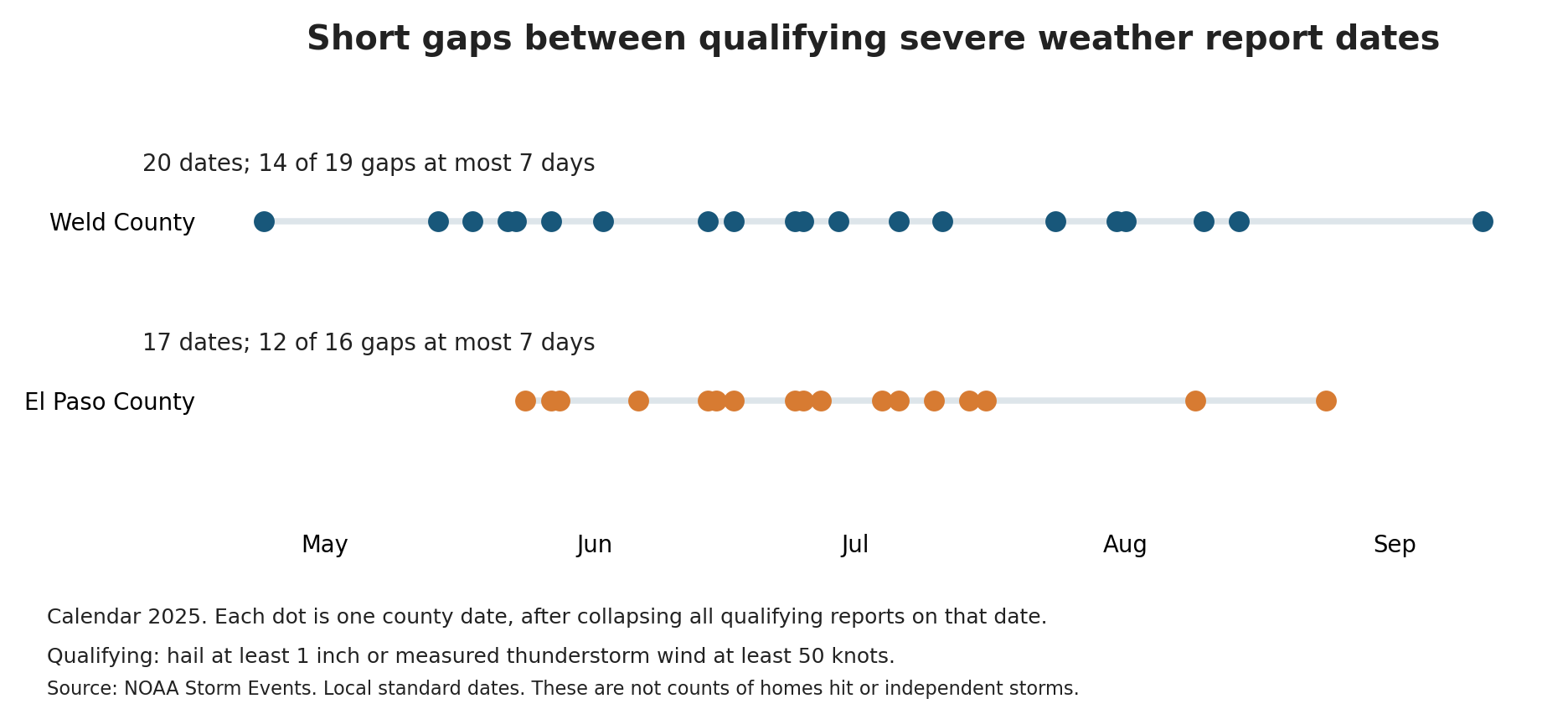
Read all 37 county dates and their preceding gaps
| County | Date | Gap from previous qualifying date (days) |
|---|---|---|
| Weld | 2025-04-24 | — First date |
| Weld | 2025-05-14 | 20 |
| Weld | 2025-05-18 | 4 |
| Weld | 2025-05-22 | 4 |
| Weld | 2025-05-23 | 1 |
| Weld | 2025-05-27 | 4 |
| Weld | 2025-06-02 | 6 |
| Weld | 2025-06-14 | 12 |
| Weld | 2025-06-17 | 3 |
| Weld | 2025-06-24 | 7 |
| Weld | 2025-06-25 | 1 |
| Weld | 2025-06-29 | 4 |
| Weld | 2025-07-06 | 7 |
| Weld | 2025-07-11 | 5 |
| Weld | 2025-07-24 | 13 |
| Weld | 2025-07-31 | 7 |
| Weld | 2025-08-01 | 1 |
| Weld | 2025-08-10 | 9 |
| Weld | 2025-08-14 | 4 |
| Weld | 2025-09-11 | 28 |
| El Paso | 2025-05-24 | — First date |
| El Paso | 2025-05-27 | 3 |
| El Paso | 2025-05-28 | 1 |
| El Paso | 2025-06-06 | 9 |
| El Paso | 2025-06-14 | 8 |
| El Paso | 2025-06-15 | 1 |
| El Paso | 2025-06-17 | 2 |
| El Paso | 2025-06-24 | 7 |
| El Paso | 2025-06-25 | 1 |
| El Paso | 2025-06-27 | 2 |
| El Paso | 2025-07-04 | 7 |
| El Paso | 2025-07-06 | 2 |
| El Paso | 2025-07-10 | 4 |
| El Paso | 2025-07-14 | 4 |
| El Paso | 2025-07-16 | 2 |
| El Paso | 2025-08-09 | 24 |
| El Paso | 2025-08-24 | 15 |
The wind definition changes Weld’s count
The stricter wind filter matters. Including one estimated wind report adds a Weld date, changing its count from 20 to 21 and its short-gap count from 14 of 19 to 15 of 20. El Paso’s figures do not change. Hail-only counts are lower: 16 dates in Weld and 15 in El Paso. The full sensitivity file also tests larger hail thresholds and other gap lengths.
| County | Definition | Dates | Gaps ≤7 days |
|---|---|---|---|
| Weld | Preferred: ≥1-inch hail or measured wind ≥50 knots | 20 | 14 of 19 |
| Weld | Sensitivity: ≥1-inch hail or any reported wind ≥50 knots | 21 | 15 of 20 |
| Weld | Sensitivity: ≥1-inch hail only | 16 | 8 of 15 |
| Weld | Sensitivity: ≥2-inch hail or measured wind ≥50 knots | 10 | 5 of 9 |
| El Paso | Preferred: ≥1-inch hail or measured wind ≥50 knots | 17 | 12 of 16 |
| El Paso | Sensitivity: ≥1-inch hail or any reported wind ≥50 knots | 17 | 12 of 16 |
| El Paso | Sensitivity: ≥1-inch hail only | 15 | 8 of 14 |
| El Paso | Sensitivity: ≥2-inch hail or measured wind ≥50 knots | 5 | 3 of 4 |
The preferred series excludes the estimated gust reported in Weld on July 7, 2025. The broader series includes it. The sensitivity CSV also includes report-row counts and gaps of at most 3, 14 and 30 days.
Methods and limits
The source is the full calendar-2025 NOAA Storm Events details file, creation/revision date August 19, 2026. Its compressed SHA-256 is d9b46b4c6aae554723cadbb9691f3d5258371c02e530ba815d6fe41e4550149f. A fresh retrieval on October 25, 2026 matched the archived source exactly. NOAA can revise historical records; these results describe this frozen revision. Source definitions
Select Colorado (state FIPS 08), county-coded records (CZ_TYPE C), and county FIPS 123 (Weld) or 041 (El Paso). Keep hail magnitudes at least 1 inch, or thunderstorm-wind magnitudes at least 50 knots with measured gust (MG) or measured sustained (MS) codes. The selected wind rows are all MG. Hail reports are not restricted to instrument measurements. Tornadoes and other hazards are outside this definition. Source definitions
Use exact decimal magnitude comparisons. Build dates from BEGIN_YEARMONTH and BEGIN_DAY and check them against BEGIN_DATE_TIME. All included records use MST-7 local standard time; these are not UTC or daylight-saving civil dates. Several qualifying hazards or reports on one county date count once. Source definitions
Sort each county’s unique qualifying dates. Each adjacent pair contributes one gap, measured by calendar-date subtraction. Thus 20 dates yield 19 gaps, and 17 dates yield 16 gaps. The denominator excludes intervals before the first or after the last qualifying date. A gap of one day means adjacent dates, not a full storm-free day; no qualifying report is not proof that no weather occurred. Source definitions
The 168 preferred rows contain distinct NOAA event IDs: Weld has 55 hail and 15 measured-wind rows; El Paso has 92 hail and 6 measured-wind rows. No selected row crosses a local-standard calendar date. Event rows and dates are not independent storms; NOAA episodes can include multiple events. Source definitions
Sensitivity variants retain the same county/date aggregation: Base permits estimated as well as measured wind at 50 knots; HailOnly excludes wind; LargeHailPlusMeasuredWind raises hail to 2 inches and keeps measured wind at 50 knots. The added Base date in Weld is July 7, 2025 (event 1261443, EG). The downloadable table also checks gaps of at most 3, 14 and 30 days.
These two counties were selected after an exploratory national screen, not as a representative sample or a national risk ranking. Coverage and reporting practices differ between places. This single-year analysis concerns documented report dates somewhere in each county, not repeated impacts at a home, citywide risk, repair delays, damage, claims, premiums, trends or climate attribution. It does not change HomeRiskIQ scoring.
The public evidence contains only the selected Colorado county hail/wind records, preserving NOAA columns and row values in a reserialized CSV. It retains nonqualifying magnitudes and estimated wind for sensitivity checks. The original national gzip is linked at NOAA, not bundled. The offline Python script verifies the subset checksum and all four result tables; its optional upstream check verifies the exact full-source hash and subset extraction.
Read, inspect and reproduce
The evidence ZIP includes the public HTML report, unchanged original timeline, Colorado source subset, result tables, source hashes and Python code. Extract it and run python3 reproduce.py; Python’s standard library is sufficient. Keep the HTML and PNG together for offline reading. The original national source remains available from NOAA.
Sources
Related HomeRiskIQ research
What annual flood-day totals leave out examines a different aspect of timing: sampled high-water persistence at three NOAA gauges.
The Texas coastal gauge study compares official flood-day totals with consecutive hourly readings. Gauge persistence and the spacing of county weather reports measure different things.
Browse all research or read the HomeRiskIQ scoring methodology.