Wisconsin AQI coverage · 2025 research
A complete county AQI calendar can conceal gaps in individual pollutant records
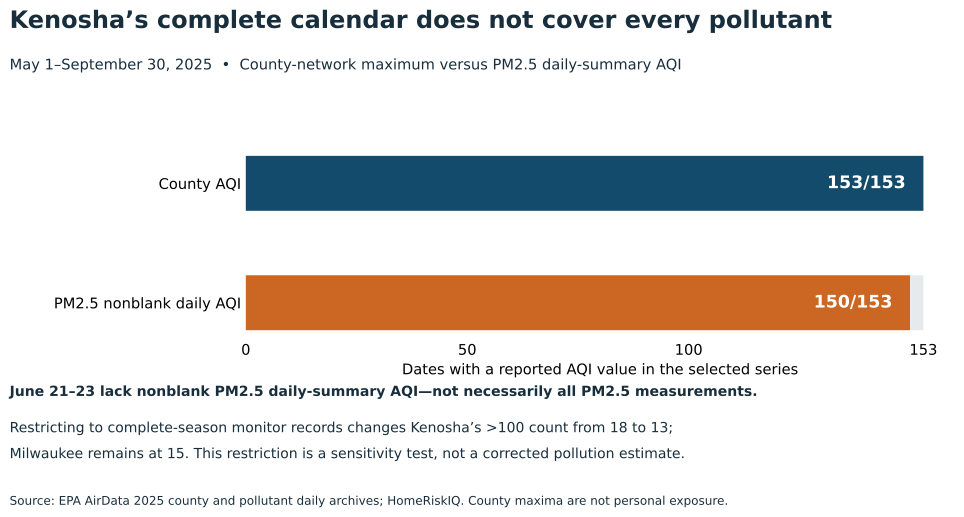
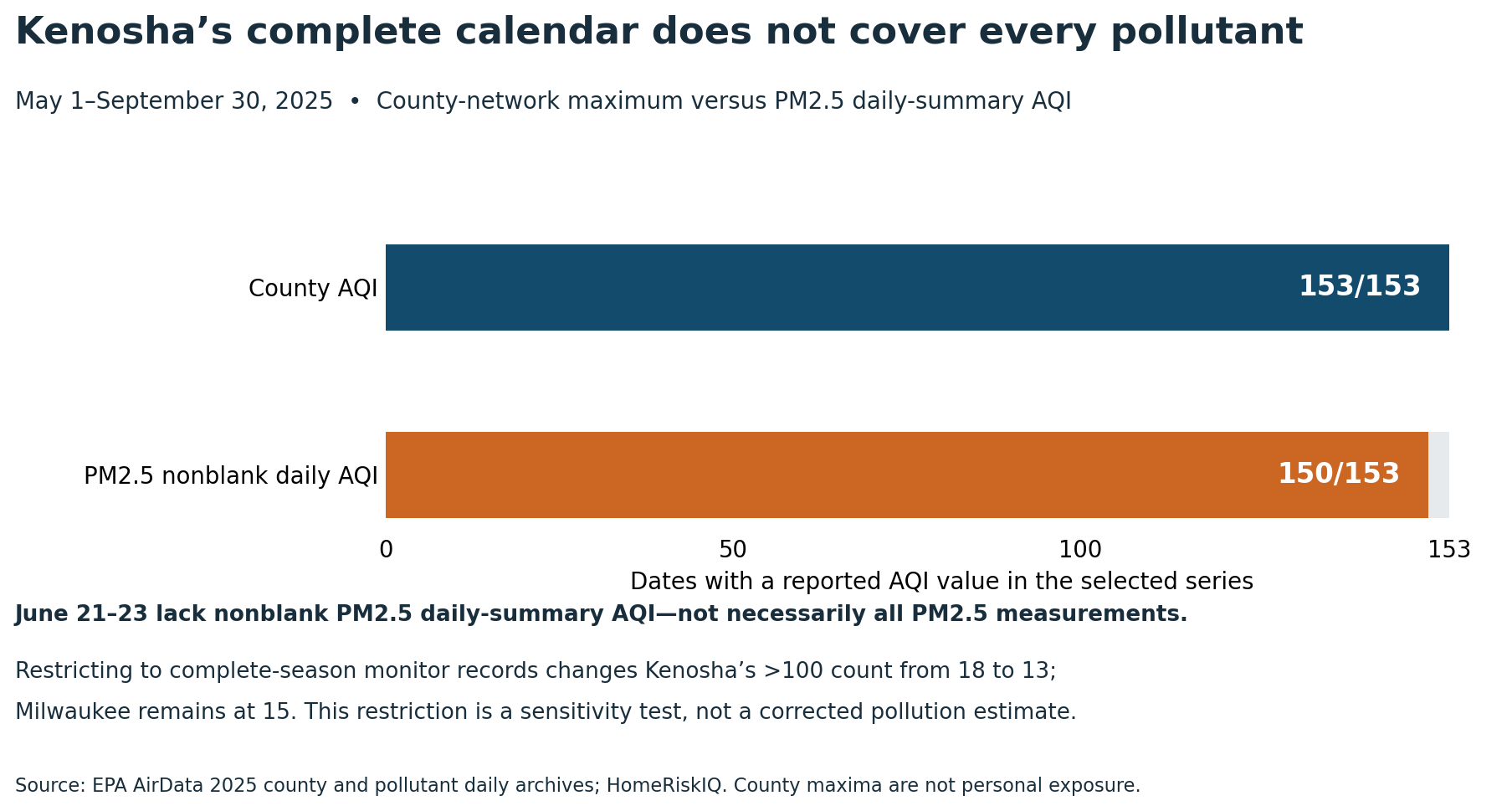
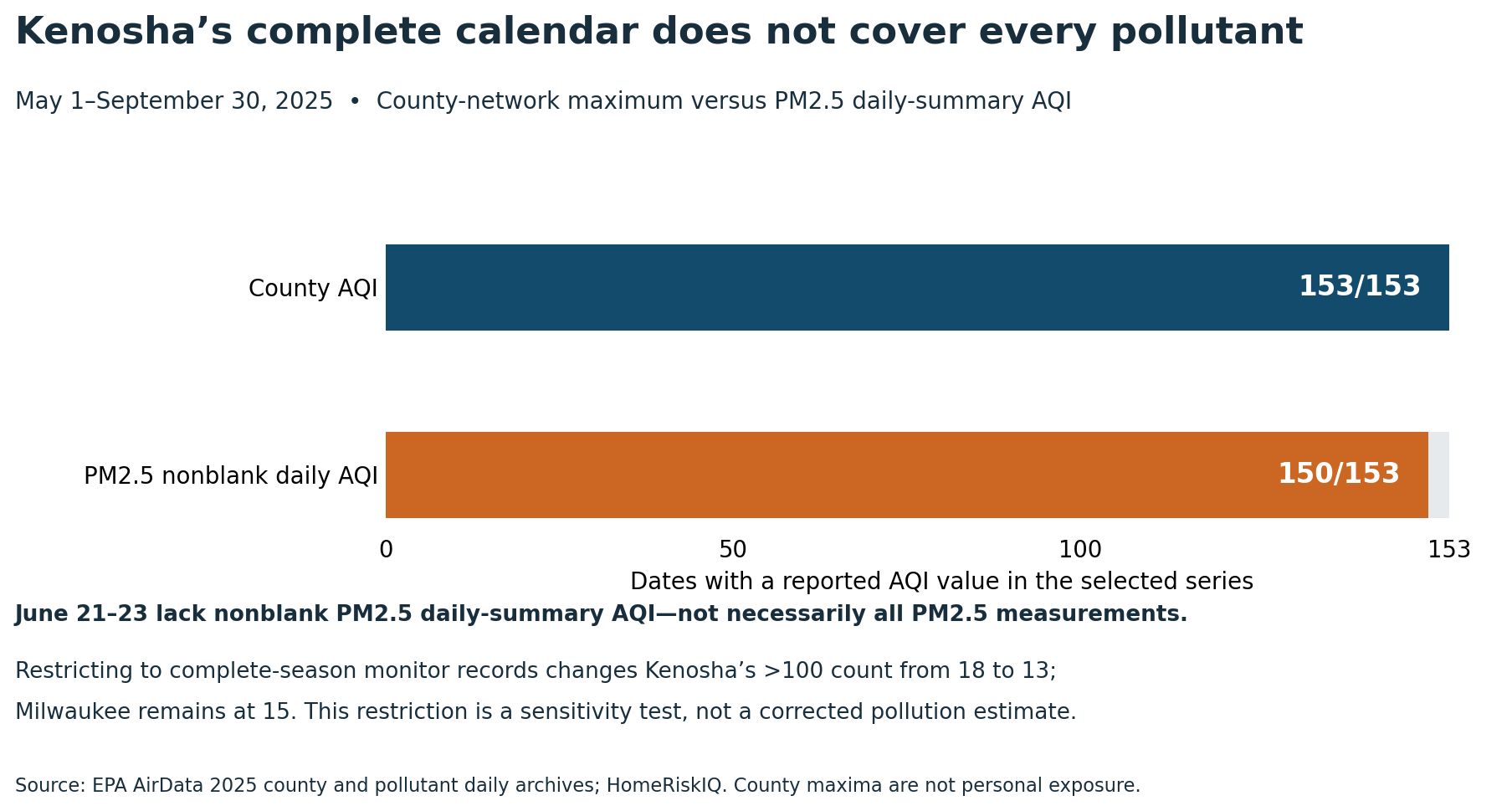
Kenosha County had a reported air-quality index on all 153 dates from May through September 2025. Its downloaded PM2.5 daily summaries, however, contained nonblank AQI values on 150 of those dates. The three missing dates were June 21–23. A complete county calendar did not mean a complete daily AQI record for every pollutant.
That distinction matters when neighboring counties are compared. In the EPA county archive, Kenosha had 18 dates above AQI 100 during the five-month window and Milwaukee had 15. Restricting the monitor calculation to site–pollutant–POC records reporting a nonblank AQI on every date reversed that ordering: Kenosha had 13 and Milwaukee still had 15. A simple fewer-days comparison was not stable under the change in panel.
The narrower calculation is not a correction to EPA's county figure. It intentionally discards records without complete-season AQI coverage, including Kenosha's PM2.5 series. Those omissions can remove real recorded pollution dates. It is a test of how much the comparison depends on which records are retained, not evidence that the official count is wrong or that Kenosha's air was cleaner.
| Series | Nonblank AQI dates | Window dates |
|---|---|---|
| County AQI | 153 | 153 |
| PM2.5 nonblank daily AQI | 150 | 153 |
Scroll the table horizontally on smaller screens. Full-precision values and definitions are in the chart-data CSV and evidence ZIP.
Persistence told a different story
One contrast survived the same restriction. Milwaukee's longest run above 100 was six consecutive dates, July 31–August 5. Kenosha's longest was three, August 5–7. The complete-season monitor panel retained those six-day and three-day runs.
The monitor geography matters as well. Milwaukee's six-day sequence was present at the Sixteenth Street site. Kenosha's three-day county sequence was assembled from readings at different sites; neither individual site had a run longer than two dates. A county maximum can move between locations from one day to the next. It should not be narrated as three days of identical conditions at every address.
EPA's area AQI display takes the highest daily value among reporting monitors. During this window, the county file listed four reporting sites each day in Milwaukee and two in Kenosha. The seven pollutant daily archives contained 13 distinct site–pollutant–POC combinations with nonblank AQI somewhere in the window in Milwaukee and four in Kenosha. Seven and three, respectively, reported nonblank daily AQI throughout the window. These are monitoring-record identifiers, not a count of unchanged physical instruments.
The Wisconsin State Climatology Office described a nine-day air-quality advisory span from July 29 through August 6. That is a different measure from this article's observed county runs. The two should not be substituted for one another. Nor does a PM2.5 label independently establish that a particular measurement came from wildfire smoke.
HomeRiskIQ used May 1–September 30 to compare the same dates, not to call it a full-year tally. The full-year source itself reinforces the coverage issue: Milwaukee had 365 reported county dates in 2025, while Kenosha had 347. The missing dates are not assumed clean. The latest bulk files checked on October 30, 2026 still made 2025 the latest full calendar year available for this retrospective analysis.
The lesson is not that AQI data are unusable. It is that the denominator belongs beside the result. Report the dates available, the pollutant coverage and the aggregation rule before turning a county count into a comparison. These records measure outdoor monitoring conditions, not indoor exposure, health effects, housing prices or damage to homes.
Data note
Above 100 means Unhealthy for Sensitive Groups or worse. Missing dates break runs; event-inclusive observations are retained. Thirteen exact daily county values differ from maxima of nonblank daily pollutant-summary AQIs in these two counties; none changes the above-100 classification. The official county series supplies headline calendars. The evidence bundle preserves those differences and does not claim exact algorithmic equivalence.
Methods and interpretation limits
The canonical series is EPA county daily AQI. The analysis window is May 1–September 30, 2025: 153 dates and 22 complete Saturday–Sunday pairs. Missing dates break runs; a qualifying weekend has at least one date strictly above the stated threshold. County maxima are not county averages or personal exposure.
Across the nine-county validation dataset, 24 exact daily values remain different between the county archive and maxima of nonblank daily pollutant-summary AQIs. All 1,377 of 1,377 above-100 classifications agree. This agreement does not resolve the exact discrepancies or establish algorithmic equivalence. The download retains all eight raw archives and the discrepancy rows.
Complete-season panels require nonblank AQI for every date at the stated site–pollutant–POC combination. Blank AQI does not establish missing measurements or clean air. Counties were selected after exploratory inspection; no national ranking, current forecast, causal attribution or property-level risk is inferred.
Read the full archived methodology. The evidence ZIP preserves frozen source files, source provenance and reproduction scripts.
Sources and context
Data and chart downloads
The evidence download is shared with the related studies that use the same source files. Keep the original folder layout when extracting it. Source and sensitivity records retained for reproducibility do not constitute additional published stories.