Grant County winter zones · 2025 research
Grant County has two winter weather histories in NOAA records
A county name can be too coarse a starting point for understanding winter weather. In Grant County, West Virginia, NOAA's 2025 Storm Events archive separates Western Grant from Eastern Grant. The two forecast zones have noticeably different records, even though they sit within the same civil county.
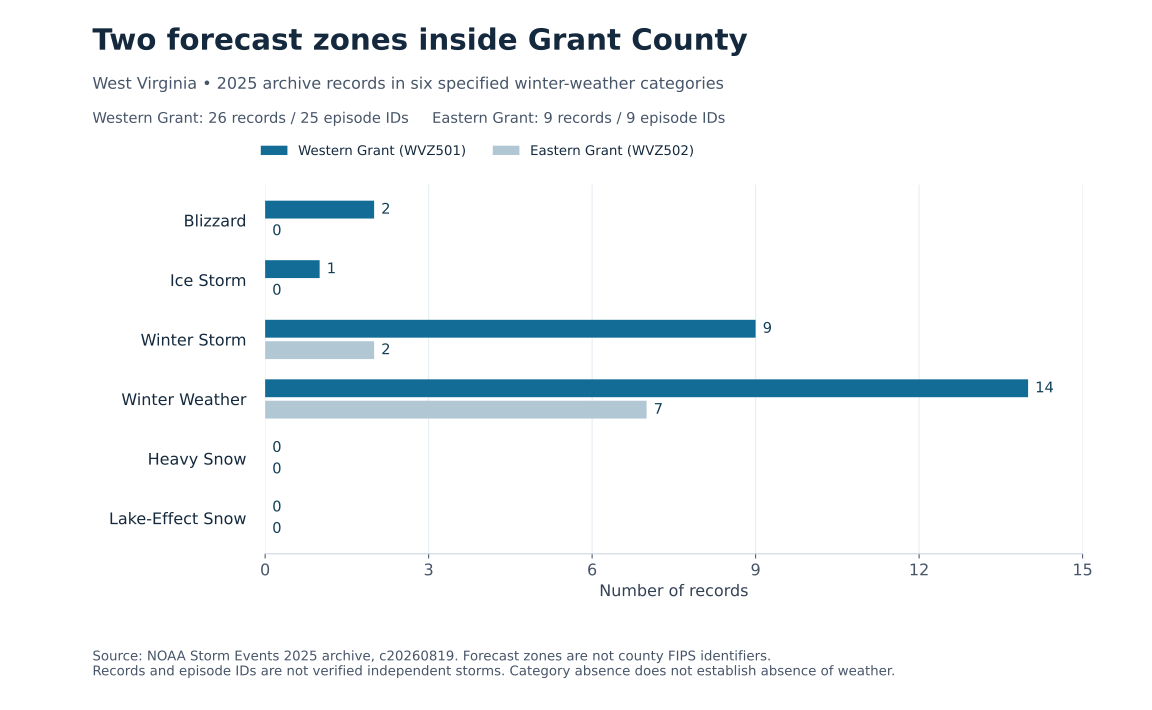
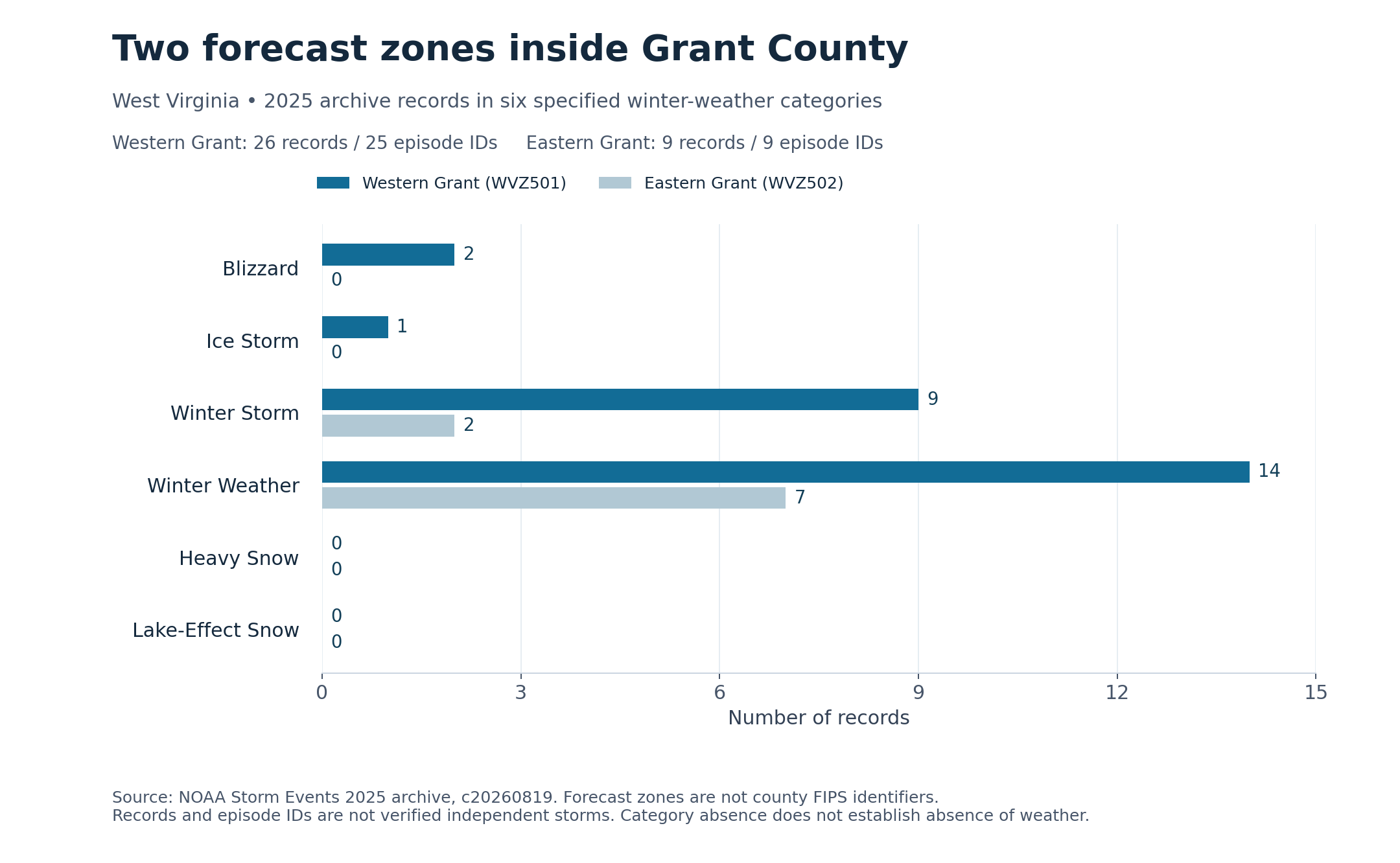
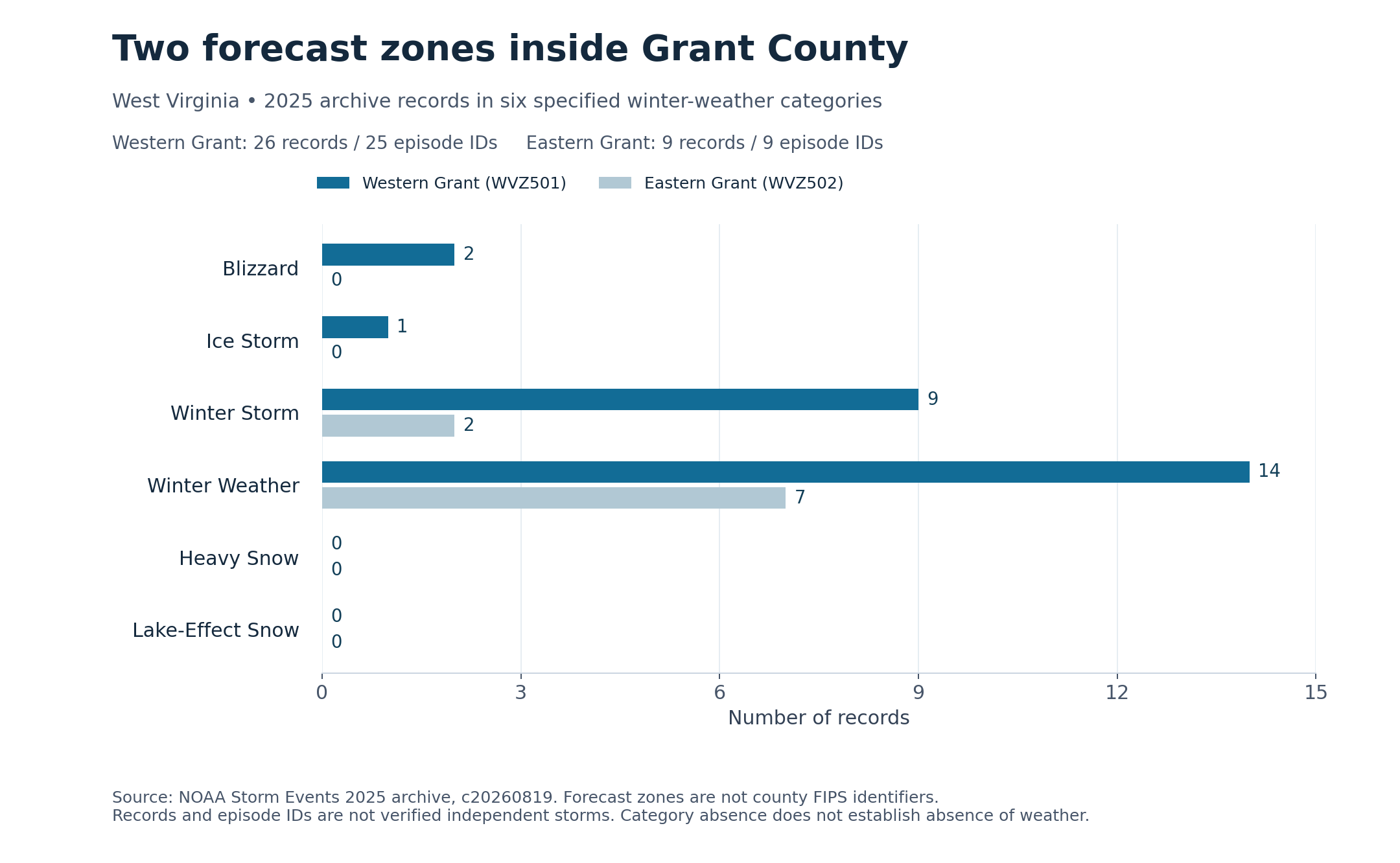
HomeRiskIQ found 26 records across six specified winter-weather categories for Western Grant and nine for Eastern Grant in the complete 2025 archive downloaded October 31, 2026. These are reported event records, not separate storms or a measure of each home's exposure. Their value is in showing what a single county total would hide. NOAA source archive
The geography is part of the finding
The Weather Service's forecast selector lists Western Grant and Eastern Grant separately. Their public forecast-zone identifiers are WVZ501 and WVZ502. In the Storm Events file, both have a geography-type code of Z, meaning a public forecast zone rather than a county. NWS forecast selector, NOAA geography definitions
A data user who treats the accompanying numbers 501 and 502 as county codes will be joining the wrong kinds of geography. A reader who simply combines the two names loses a different kind of information: the Weather Service may document different conditions in different parts of Grant County during the same episode.
The western records include two classified as Blizzard, one as Ice Storm, nine as Winter Storm and 14 as Winter Weather. The eastern records include two Winter Storm and seven Winter Weather entries. Neither zone has a Heavy Snow or Lake-Effect Snow record in the selected set. An absence from one category is not a claim that no snow fell there.
| Forecast zone | Category | Records |
|---|---|---|
| WVZ501 Western Grant | Blizzard | 2 |
| WVZ501 Western Grant | Heavy Snow | 0 |
| WVZ501 Western Grant | Ice Storm | 1 |
| WVZ501 Western Grant | Lake-Effect Snow | 0 |
| WVZ501 Western Grant | Winter Storm | 9 |
| WVZ501 Western Grant | Winter Weather | 14 |
| WVZ502 Eastern Grant | Blizzard | 0 |
| WVZ502 Eastern Grant | Heavy Snow | 0 |
| WVZ502 Eastern Grant | Ice Storm | 0 |
| WVZ502 Eastern Grant | Lake-Effect Snow | 0 |
| WVZ502 Eastern Grant | Winter Storm | 2 |
| WVZ502 Eastern Grant | Winter Weather | 7 |
Scroll the table horizontally on smaller screens. Full-precision values and definitions are in the chart-data CSV and evidence ZIP.
One episode can have two descriptions
The contrast is clearest in the paired records, not just the annual totals. For the episode beginning February 5, Western Grant is classified as Ice Storm and Eastern Grant as Winter Weather. The shared episode narrative describes freezing rain and contrasts icing along the eastern-facing slopes with lesser amounts in valleys. The western event narrative also records downed trees reported by the state highway department.
A second episode, beginning February 12, is classified as Winter Storm in Western Grant and Winter Weather in Eastern Grant. The western event narrative identifies the greatest icing in Mount Storm and reports downed trees. The eastern event narrative is blank. That blank does not establish an absence of impacts in the eastern zone; it limits what this source says about them.
These examples give the zone distinction a practical purpose. A household trying to understand past disruptions should not assume a county-wide label describes the same conditions on every route home. Conversely, a record somewhere in a forecast zone does not establish that every address inside the zone experienced the documented conditions.
Counts need a second label
Western Grant's 26 records belong to 25 distinct episode identifiers. Eastern Grant's nine records belong to nine episode identifiers, all also represented in the western set. Counting episode identifiers therefore reduces the western total by one, but does not turn the result into a verified count of physically independent storms. NOAA defines episodes as groupings that can contain multiple events.
The analysis includes Blizzard, Heavy Snow, Ice Storm, Lake-Effect Snow, Winter Storm and Winter Weather. It excludes other categories, including cold and frost, so the totals should not be described as every winter hazard. The comparison is exploratory and descriptive, with no adjustment for area, population, observation opportunities or property characteristics.
For people using historical weather information to plan for winter, the useful next step is geographic: identify the forecast zone serving the actual location, then read the specific event narrative and current local forecast. The 2025 contrast does not predict next winter's losses. It shows why keeping the Weather Service's within-county distinctions can make a weather history more informative than a single number beside the county name.
Methods and interpretation limits
The frozen NOAA 2025 details archive was retrieved October 31, 2026; its creation date is August 19, 2026. Records and episode identifiers do not automatically count independent physical storms. Administrative reporting, category selection, missing context and source revisions limit interpretation.
These purposively selected cases explain database identity, timestamps and geography. They do not estimate home exposure, future loss, climate trends or property-level risk, and do not alter the site’s scoring model.
WVZ501 and WVZ502 are forecast zones, not county FIPS codes. The western 26 records/25 episode IDs and eastern 9/9 cover six specified categories in calendar 2025, spanning two winter seasons. Category absence and blank narratives do not establish absence of weather or impacts.
Read the full archived methodology. The evidence ZIP preserves frozen source files, source provenance and reproduction scripts.
Sources and context
Data and chart downloads
The evidence download is shared with the related studies that use the same source files. Keep the original folder layout when extracting it. Source and sensitivity records retained for reproducibility do not constitute additional published stories.